.png)
.png)
Interview: Rowena Wise

Interviewed by Olive McCagh

Bad Things Feel Good* is the second album to come from Naarm-based songwriter Rowena Wise, and the title honours the way she transforms her hardships into rich lullabies. There is a thin line between Rowena’s artistry and her identity; her music was born when she was. Self-reflection is the driving force of the record; it acts as the navigator in the world of love, grief and alienation. Diving into a conversation with Rowena shows her thoughts are as deep as her music; it’s always an honour to discuss art as meaningful as this.
I want to go back to the beginning, because I read you grew up touring in a family band with musical ties throughout your whole childhood. I was wondering how your youth shaped your musical identity.
I was born into a family band. My father's a guitar builder; he's a luthier, and my mum is a folk musician from the US. So, my two older sisters and I, from when I was eight years old, we all played as a family band at festivals all around Australia. We used to drive across the Nullarbor every summer, which was like five days drive just to play at festivals.
It was really beautiful getting to experience, from such a young age, the power that music has. And just the feeling of connection you can have with complete strangers through this common ground of music; it just transcended so many different geographical boundaries. It just felt like magic, and I felt compelled to keep doing it into my adulthood.
It was so enriching to experience travelling. I remember there were some harrowing times, like when we had a layover at Heathrow Airport when we toured Ireland, and the layover was eleven hours. It was five of us with all of our gear trying to find somewhere to sit for eleven hours, and it turned out to be this arcade corridor where the arcade game sounds wouldn't stop playing for eleven hours.
And I can still remember some of those sounds. But all worth it. It's been a beautiful journey.
I feel like that's quite a unique experience to have, and it makes sense as you've got such a strong bond with music; I feel like it really comes naturally to you and your identity.
I was wondering about the landscape of Margaret River and if your hometown has left any fingerprints on your sound.
That's a great question. Margaret River is comprised of one main street, and when I was growing up there, it wasn't as gentrified yet.
So, it really felt like you could walk down the main street and there was no anonymity; everyone knew you, this real feeling of closeness and community. The intimacy of growing up in a small town, especially one that's on the ocean, where people surf, and there are rainforests and big cave systems, there's so much to explore. I felt really lucky.
Although that feeling didn't arise until after I left, you know, everywhere you grow up, you take for granted. I just wanted to move to Melbourne since I was like 12. But Margaret River, the spaciousness of growing up somewhere like that, and yet the closeness of growing up in a smaller community, I think it has left these fingerprints on what I'm interested in writing about thematically, and the world-building within my songwriting: the time, place, and the visuals.
You recorded the album in three days with Rob Muinos, whom you've worked with before. I was wondering what your working relationship is like with Rob.
Rob is wonderful to work with. He cares about putting the story front and centre in a song. That could be lyrics; that could be the emotion painted by the music, by the band. He's really good at capturing humanity in stuff.
For instance, I felt creatively challenged in a way sometimes when we'd be going through vocal takes after a really long day of recording. I'd be thinking, ‘I'm not sure if we've got it. I'm not sure if I sound any good.’
It's confronting recording vocals live with the band. Then we'd select a take for a part that sounded the most flawed, the most imperfect to me, and he would go, ‘That sounds the most convincing. I can hear the story coming through in that part. It just sounds the most interesting.’
I think that framework of thinking has left an impression on me, the way he thinks about art and that it should be relatable and human and raw and have these beautiful imperfections. Yeah, it was a really great learning curve.
I feel like it's something that can be easily lost once you get into the studio, that story. Yet embracing those imperfections can be absolutely terrifying. So, I think that's pretty incredible that there's someone who has that at the forefront of their mind. Because I'm sure that's super important to you as well.
Yeah, for sure. I remember the performances we kept were often the performances where I stopped protecting my voice and would just listen to the band and feel the band. We'd all listen to each other.
I'd take a breath that was slightly too loud or push a note until it frayed at the edges or reached the end of the line and hear my voice begin to crumble. But those were the really special moments. It was awesome to do that with really talented friends playing the room with me. In that tiny room, it was mesmerising.
That's incredible. I'm sure that moment will stay with you forever, recording the album.
I wanted to talk about your band as well, because I can imagine as a solo artist who’s telling such vulnerable stories. There's so much trust in your band to reflect those and to hold them with the same care that you do. So, I was wondering how you went about putting together your band.
I worked with Richard Bradbeer on bass for this album, Matt Dixon on pedal steel, and Jess Ellwood on drums. They were all on my first album as well.
So, we already had this creative connection that was really special. And they held these really good, strong connections with Rob as well. They worked with him quite a lot.
I just felt like we all had this real respect and trust for each other and patience working out all the songs. There was something slightly reckless about deciding to do it over three days. But when you're working with people that you've worked with before, and they're all very skilled and can bring their own beautiful energy to the song, it's appropriate for this kind of album, for Bad Things Feel Good.
And the time limit meant we couldn't keep reopening every decision. There's a lot of trust there. We had prepared before entering the studio. Everyone had prepared separately. But once we were in the room, that was the first time we played the songs together, and we had to trust what happened between us.
There wasn't enough time to polish every wobble, or rebuild every song in tiny, perfect pieces. A three-day deadline made us value instinct over perfection. You can just feel it in your gut rather than think it. It meant that when something was beautiful and imperfect, we had to trust it and let it be enough.
Definitely. That's such a beautiful way to put it and an amazing framework to make music in. I think it's probably the most authentic way.
You spoke of creative connection. Is that something you find difficult to have with people?
No. I think that I'm pretty malleable. I actually really enjoy when there's a lot of dichotomy and opposites going on between my creative energy and someone else's creative energy.
Because where the tension lies in the overlapping circles in that Venn diagram is where the special stuff is made. I think the more different you are from someone you're working with, the more interesting the stuff you're making. So, I just try and look for that.
If you're in a similar vein of the way you approach creating stuff, the process may be easier, but perhaps what you come up with is just too similar to what you usually make. So, you can always find value in working with whoever, no matter how different you are.

I was wondering who the first person you shared your music with is?
Well, I remember the first song that I wrote by myself. I think I was eleven years old, and it was a pretty epic song. It was like an eleven-minute anti-war song called ‘Echoes from the Past’.
It's funny that me living my beautiful, sheltered, young life in coastal Margaret River, writing a song of that scope. I don't remember it being a particularly good song, but I played it at the dinner table, and we had some musical family friends staying with us from over in the East. And there were like six adults and a few kids, and everyone quietly listened for the whole eleven minutes, and it was a very encouraging space for sure.
But I can imagine they would have heard me start the fifth verse and go, ‘oh, wow, it's still going’. That's the first moment, but I'm sure when I was a kid, I would have been singing opera on top of monkey bars at my mum and stuff.
Do you still share a lot of your music with your family? Are they some of the first to hear it? Do they still play a role?
I don't think so.
I care about what they think, but I write more for myself now. A lot of the songs that I've been writing about- a lot of the themes are quite confronting about emotion and atypical ways of approaching mental health, relationships, self-destruction, and self-possession, and they're quite nuanced. I think that’s because I write them for me.
I do share the album with my family before it's out; I'll send a link out. But yeah, it's mainly for me if that makes sense.
What a way to be, and what a fulfilling way to create for yourself, I'm sure.
On that note, I wanted to ask you when you feel most connected to your songs - whether that's during the writing phase, recording, performing, or listening back - when do you feel most connected?
There are different levels of connection, and it's never really about when I'm most connected, because I'm always connected in different ways.
I think definitely writing; I love that raw, sort of nebulous connection of writing the song initially, like I wrote Bad Things Feel Good, all those songs when I was really busy on tour. I was moving around a lot and coming home for a week and then going away again. So I was feeling pretty displaced, and I think that provided this strange objectivity on my emotional state. Especially when I was travelling so much, touring and realising I was carrying all of the emotional turmoil with me, so I couldn't outrun it. And I loved that connection of trying to tap into what I was feeling.
Then the process of recording and repeating the songs over and over is this weird connection where you're kind of immortalising the music in a way and trying to present it with this immediacy of performing with a live band. I love that connection.
Then there's performing the songs once they're out, which is maybe my favourite. I lied; I do have a favourite.
I feel most connected when I'm playing them in front of an audience because the songs aren't mine anymore. I love that they are just out in the ether and I don't have control over them anymore, or how people connect with them. Everyone's going to have their own connection.
I love that; it just feels like I'm releasing them, and I'm letting go of the weight, and the meaning of the songs is renewed when I know that there are new sets of ears listening to them, having just their own intrinsic understanding. It's pretty cool.
Do you have a favourite song on the album?
Well, I think my favourite song is the opening track of the album, which is the most recent single, Home In This World. It came from a feeling I've carried for most of my life but only found language for as an adult. The song began when I stopped trying to argue with a feeling of loneliness and considered that perhaps purpose isn't waiting somewhere for us to discover. Purpose might be something we create through how we live and connect. The song is about feeling small in the universe and wondering where your place is.
This song holds that experience of looking up at the night sky and realising the loneliness of being one tiny consciousness. And the awe of realising that, in some way, it feels like you belong to everything. It's a weird song. It's like this isolation and joy and connection all in one. I love that song for it; it's really fun to play. It's very nuanced.
I'm always surprised by how many people say after the recent gigs how much they connect with that song. So, it's my favourite.
Is that the reason you put it first?
I put it first because I think, firstly, it didn't really make sense flow-wise anywhere else in the album. But secondly, I really liked the tone it sets for the album. It's this intricate fingerpicked nylon guitar vibe.
It was recorded in this bathroom down the hall from the studio in this really old building in Collingwood. So, you can hear this real time and place that gives it this immediacy. Then the themes are about feeling small and embracing that.
And they're quite lofty and macro-lens. I like that the album is starting with this, who am I? And what am I doing vibe? Because when it hones in on these closer, to-the-bone emotions of love and loss and mental health for the rest of the album, it feels like there's this undercurrent of, ‘your human experiences are part of something greater’
I want you to paint me a picture of the perfect listening experience front to back of Bad Things Feel Good
I think listening to it in a liminal space that's moving somewhere between A and B. Listening to this album when you're sitting on the tram looking out the window, or in the car driving somewhere, to go across a vast landscape, listening to it on an aeroplane, 30,000 feet above the earth. Just somewhere that's removed from where you usually dwell.
I love listening to music like that myself; it feels like there are more moments when I hear a line in a song, and I recognise an experience that I've never been able to explain. It usually happens when I'm feeling far from home, and a bit more malleable in my sense of self.
I've got one more question, because your album kind of focuses on letting go of the beauty of uncertainty. Have you been practising any habits to allow yourself to lean into experience?
Yeah, I do. Sometimes if I find myself overstimulated in an environment, I like to strip away some of the layers of the inner monologue and go like, ‘Okay, what's going on? What am I hearing right now?’ And then I focus on sound, and I become just a little more curious about that and every aspect.
What am I smelling? What am I feeling? What am I looking at? Just trying to focus on every sense like that. I do it when I'm in very low-key environments as well. I guess you could call it a mindfulness technique.
I especially find it interesting when I'm somewhere strange, like the supermarket, when it's 5 pm, everyone's bustling around looking stressed and trying to get their groceries before the start of the week. I just love walking around that environment and going like, ‘wow, this is paradise.’ We actually don't realise how good we have it. Look at all this food and stuff right at our fingertips.
Having a moment of gratitude for that and curiosity about it, even if you know it's at the expense of so many natural resources, having this sort of convenient life as a human. I think it is worth occasionally just having a moment of awe and joy at what we've created.
Yeah, that's how I lean into experiences a bit more. I become more mindful when I'm there. I be curious.
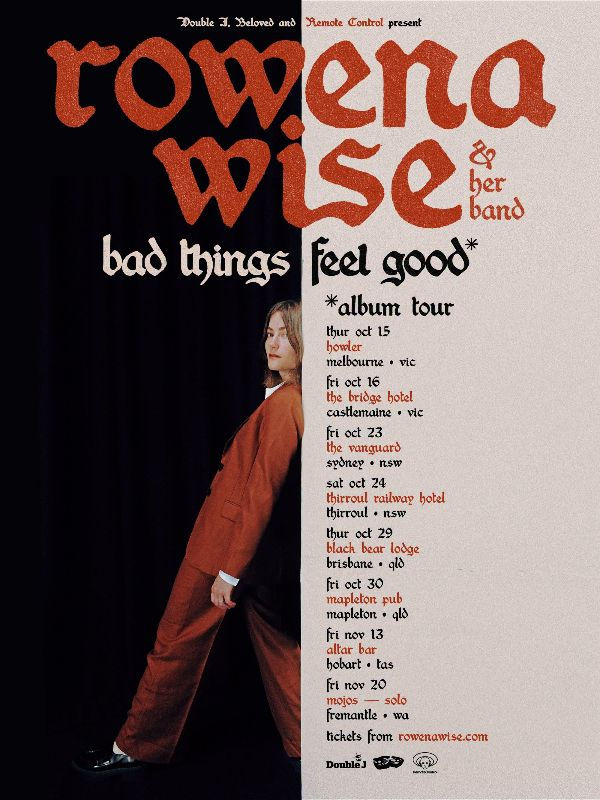
Rowena Wise is touring Bad Things Feel Good* Oct-Nov
Buy tickets here


